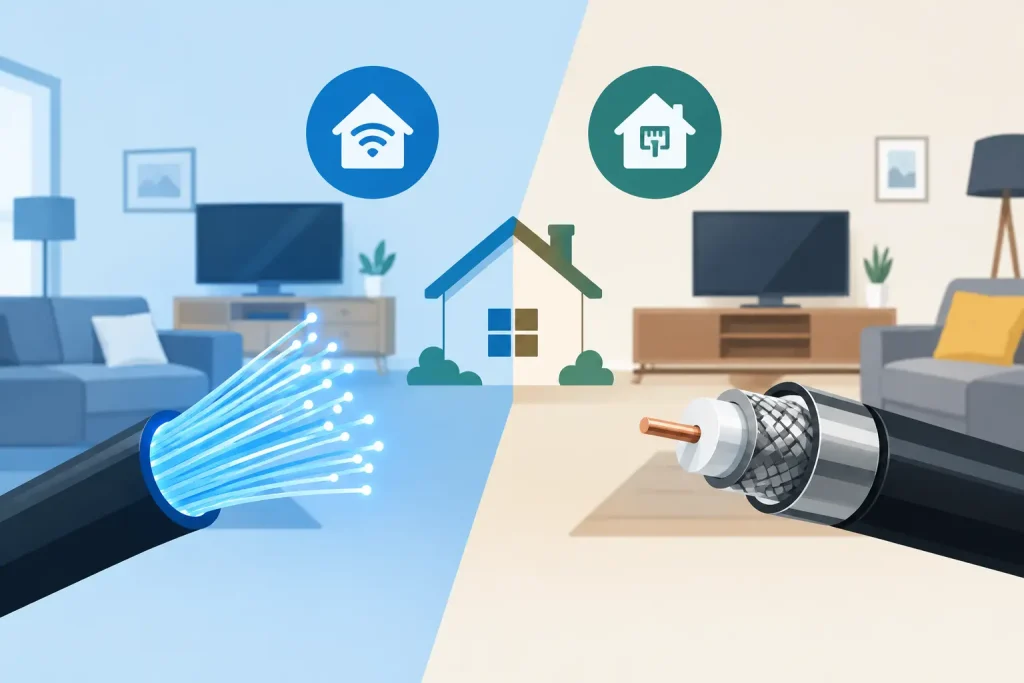
A household can have the latest smart TV, a work-from-home setup and three people streaming at once, then still be held back by the connection coming into the property. That is why fibre vs cable internet is worth understanding before choosing a plan. The better option is not always the one with the most impressive label. It is the connection available at your address, matched to how your household actually uses the internet.
For most Australians, the choice is shaped by the NBN or a private network such as Opticomm. Your technology type affects potential speeds, upload performance and how well the connection handles busy periods. But it is only one part of the picture. Your plan, in-home Wi-Fi and provider support matter too.
Fibre vs Cable Internet: The Key Difference
Fibre internet uses fibre-optic cables to carry data as light. These cables are built for high capacity and low signal loss over distance. Where fibre runs all the way to your premises, it generally offers the strongest long-term performance for demanding households.
Cable internet usually refers to Hybrid Fibre Coaxial, or HFC. It uses fibre for much of the network, then a coaxial cable for the final stretch into the home. So it is not an old-fashioned connection in the way people sometimes assume. HFC can deliver fast NBN services and works very well for many homes.
The practical difference is in that final part of the network. Full fibre connections have more headroom for very high speeds and stronger uploads. Cable networks rely on shared local infrastructure and were originally designed with more emphasis on downloads than uploads.
That does not make cable a poor choice. It means you should judge it against your needs, not against a blanket claim that one technology is always better.
Fibre Internet: Best for High-Demand Homes
Fibre-to-the-Premises, often called FTTP, is the setup most people mean when they talk about fibre internet. A fibre cable runs directly to the property and connects to an NBN connection box inside.
This setup is well suited to households that need plenty of capacity at the same time. Think video calls in separate rooms, 4K streaming, large cloud backups, online gaming and smart devices all competing for attention. Fibre is also the better fit for people regularly uploading large files, such as photographers, designers, content creators and remote workers sending project files to the cloud.
Upload speed is where fibre often earns its reputation. Download speed gets the headlines because it affects streaming and web browsing. Upload speed is just as relevant when your work calls freeze, files take too long to send, or security cameras are constantly pushing footage online.
Fibre can also be a more future-ready option. As households add connected devices and services demand more bandwidth, a direct fibre connection has room to support faster plan tiers where they are offered.
There is a catch: availability is location-specific. Plenty of Australian homes are not yet connected to FTTP, and a fibre upgrade may or may not be available for your address. There can also be installation considerations, particularly for rentals, apartments or properties with difficult internal cabling.
Cable Internet: Fast Enough for Many Households
HFC cable is common in many established suburbs. It is capable of supporting fast download speeds, including plans that suit busy families, streaming-heavy homes and online gamers.
If your main internet use is watching streaming services, browsing, gaming, working from home and keeping a household connected, HFC may deliver everything you need. A good cable connection on the right plan can feel just as quick as fibre for everyday tasks.
The trade-off is that HFC upload speeds are generally lower than those available on comparable full-fibre services. This may not matter if you mostly download content. It can matter if multiple people make video calls all day, you work with large files, or you regularly back up devices online.
Local usage can play a part too. HFC capacity is shared across parts of the neighbourhood, so performance can be affected when lots of people are online at the same time. Network upgrades and provider capacity management help, but no provider can change the physical technology at an address.
That is why honest advice starts with availability. A fast, well-supported HFC service is a better choice than paying for a fibre plan that cannot be delivered to your property.
Speed Is Not the Whole Story
It is easy to compare plans by the number on the page. But a 100 Mbps plan does not automatically give every device a perfect 100 Mbps experience. The connection is shared between everyone in the home, and Wi-Fi introduces its own limits.
A household with one or two people watching HD streaming and doing general browsing may be comfortable on a lower speed tier. A family with several simultaneous 4K streams, video meetings, gaming consoles and laptops will usually benefit from more download speed. Households with frequent cloud uploads should give extra weight to upload performance, which can make fibre particularly appealing.
Your router placement matters as well. A fast fibre or cable service cannot fix weak Wi-Fi caused by a router hidden in a cupboard, thick brick walls or a large two-storey home. If the internet is good near the router but patchy in the back bedroom, the issue may be your home network rather than the connection type.
For larger homes, a mesh Wi-Fi system or a wired connection for fixed devices can make a noticeable difference. It is often the practical fix people miss while chasing a faster plan.
What Australian Homes Should Check First
Before deciding between fibre and cable, check the technology available at your exact address. Neighbours can have different connection types, especially in units, townhouses and newer developments. The network available to your home sets the realistic starting point.
Next, look at the way your household uses the connection. If reliable video calls and quick uploads are essential, prioritise a technology and plan with stronger upload capability. If your focus is entertainment, gaming and general family use, a quality HFC service may be excellent value.
Also check the provider’s typical evening speeds, not just the maximum speed tier. Evening is when most homes are online. A provider should be clear about expected performance, plan inclusions and any fees before you sign up.
Finally, ask what happens if something goes wrong. Faults can occur on any network. What matters is whether you can reach a local support team that explains the issue plainly, keeps you updated and helps get the service moving again.
The Right Connection Is the One That Fits
Full fibre is usually the stronger choice where it is available and your household needs high speeds, better uploads or room to grow. Cable internet remains a capable, practical option for many Australian homes, particularly when paired with a plan that reflects real usage.
At City Cable, the focus is on matching your address with the best available network rather than pushing a one-size-fits-all answer. No confusing jargon, no promotional traps and no pretending every household needs the same thing.
Start with what is available, be honest about how you use the internet, and choose a plan with enough breathing room for the busy times. That is how you get a connection that feels fast when it counts.