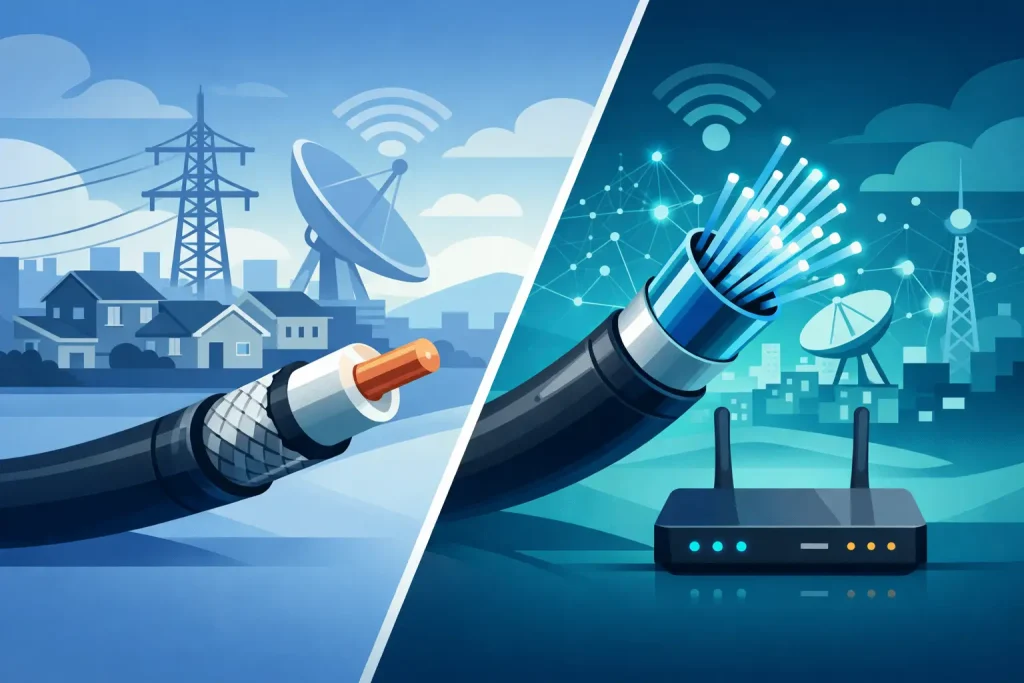
Your internet connection should not be a guessing game. When comparing cable vs NBN broadband, the right answer comes down to a practical question: what network is available at your address, and will it handle the way your household actually uses the internet?
For some homes, cable can deliver excellent performance with straightforward installation. For others, an NBN connection is the available option and may offer the speed and reliability they need. Neither label automatically means better internet. The technology at your property, your plan speed, your home setup and your provider all matter.
Cable vs NBN broadband: the key difference
Cable broadband generally uses the existing pay TV-style coaxial cable network to bring internet to a home. Depending on the network, it may use a mix of fibre and coaxial cable. This type of connection has long been common in selected Australian suburbs and can support strong download speeds for busy households.
NBN broadband is not one single connection type. It is Australia’s national broadband network, built using several technologies. Your address might be served by fibre to the premises (FTTP), fibre to the building (FTTB), fibre to the node (FTTN), hybrid fibre coaxial (HFC), fixed wireless or satellite.
That distinction matters. An NBN FTTP connection and an NBN FTTN connection can have very different performance characteristics, even when both are sold as NBN. Likewise, HFC uses cable into part of the connection, but it is delivered through the NBN network rather than a separate legacy cable service.
So, the useful comparison is not simply cable good, NBN bad, or the other way around. It is about the network available to you and the quality of the service delivered over it.
What speeds can you expect?
Speed is usually the first concern, especially when work calls freeze, shows buffer during dinner, or gaming gets laggy the moment everyone gets online.
Cable connections can offer fast download speeds and are often well suited to streaming, gaming, video calls and households with many connected devices. Actual results depend on local network capacity, the plan you choose, your modem and the condition of in-home cabling.
NBN speeds depend heavily on the access technology. FTTP is generally the strongest option for households wanting higher speed tiers and consistent performance because fibre runs directly to the property. HFC can also provide high-speed service and is a good fit for many homes. FTTN performance can be more variable because the final part of the connection relies on existing copper wiring, with distance from the node influencing potential speeds.
Do not choose a plan based on the maximum number alone. Think about what happens at peak times in your home. A couple checking email and watching occasional television will have different needs from a family with multiple 4K streams, online games, cloud backups and video meetings running at once.
Download speed is only part of the picture
Most home internet plans highlight download speed, and for good reason. It affects streaming, browsing, downloads and software updates. But upload speed deserves attention too.
Upload matters when you work from home, send large files, back up photos, make video calls or share content online. If someone in your household regularly joins meetings while another person uploads work files or uses cloud storage, a plan with stronger upload performance can make the connection feel far less congested.
Latency also matters for online gaming and real-time calls. A fast plan does not automatically guarantee low latency, but a well-maintained fixed connection and a sensible home network setup can help keep things responsive.
Availability decides more than advertising does
Australian broadband availability is highly address-specific. One side of a street can have a different network option from the other. Apartment buildings can have their own arrangements, including NBN, Opticomm or building-specific infrastructure. Newer estates may also be connected to a network that is not the same as the suburb around them.
That is why broad claims about the best internet technology can be misleading. The best connection is often the best option available at your exact property.
For renters, it is worth checking before signing up rather than assuming the connection type from the real estate listing. For homeowners, checking availability can reveal whether a network upgrade or a different access technology is possible. If you live in an apartment, ask whether the building has a communications room, existing wall socket or installation requirements that could affect activation.
Reliability: where the real trade-offs sit
Both cable and NBN broadband can be reliable. Problems are more likely to come from the specific network, local faults, in-home wiring, ageing equipment or Wi-Fi coverage than from the word printed on your bill.
Cable can be a dependable choice where the infrastructure is well established. However, shared local network capacity and older cabling in some properties can affect the experience at busy times. NBN connections can be highly reliable too, particularly fibre-based services, but the result varies between technologies and premises.
There is also a difference between your internet service and your Wi-Fi. If the connection is fine near the modem but drops out in the back bedroom, the issue may be your home wireless setup rather than cable or NBN. Thick walls, double-storey homes, crowded Wi-Fi channels and an ageing router can all reduce coverage.
Before changing plans, try placing your modem in an open, central position where possible. Keep it away from enclosed cabinets and large appliances. For workstations, gaming consoles and smart TVs, a wired Ethernet connection can be more stable than Wi-Fi.
Price should be clear, not clever
Comparing prices is not just about finding the lowest monthly figure. Some providers use short-term introductory deals, then raise the price later. Others add setup charges, modem costs, exit fees or equipment return conditions that are easy to miss.
A fair broadband plan should make it clear what you will pay, what speed tier you are receiving, whether equipment is required and what happens if you move home. If your connection needs an appointment or extra work at the property, you should know that before you commit.
It is also worth checking whether the plan has enough data for your household. Many homes now prefer unlimited data because streaming, game downloads, automatic updates and cloud backups can add up quickly. A cheaper plan is not much of a bargain if you need to ration internet use near the end of each month.
Choosing the right connection for your household
Start with availability, then match the connection and speed to your real needs. A single-person household using web browsing, social media and standard streaming may be perfectly comfortable on a modest plan. A family with remote workers, students and keen gamers will usually benefit from more speed and a reliable fixed-line connection.
If cable is available at your address, assess it on the plan performance, price transparency and support you are being offered. If NBN is available, find out the access technology before making assumptions. FTTP and HFC may suit higher-demand homes particularly well, while other NBN technologies can still be a sensible choice when matched to realistic expectations.
Support should be part of the decision too. When there is a fault, you need a provider that explains what is happening in plain English, takes ownership of the issue and does not send you in circles. City Cable helps households check the network available at their address, so the decision can be based on facts rather than big-telco sales talk.
Make the choice based on your address, not a headline
The cable vs NBN broadband debate has no one-size-fits-all winner. Cable may be the right fit in one home, while NBN fibre, HFC or another network may be the better option a few streets away. What matters is whether the connection can reliably support your household without surprise costs or support headaches.
Check what is available, be honest about how many people and devices use the connection, and choose a provider that gives you a straight answer before you sign up. Great home internet should feel ordinary in the best possible way: it simply works when you need it.