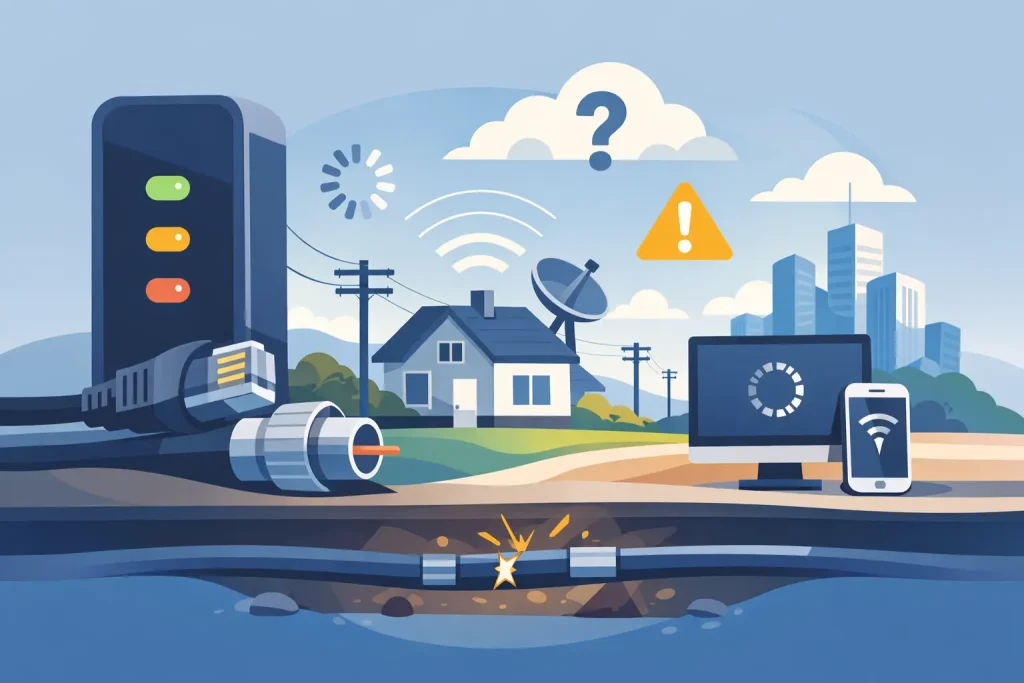
If your internet tends to fall over right when a Zoom call starts or the footy stream hits the final quarter, the question gets real fast: how reliable is cable internet? The short answer is that cable internet is usually very reliable for everyday home use, but it is not flawless. Performance depends on the local network, how busy your area gets, the quality of the in-home setup, and how well your provider handles faults when something goes wrong.
For most households, cable has a strong reputation because it can deliver solid speeds and stable performance without the distance-related drop-offs that can affect some older copper-based services. That makes it a practical option for families, renters and anyone working from home. But like every internet technology, reliability is never just about the line coming into the house. It is also about congestion, maintenance, equipment and support.
How reliable is cable internet for everyday use?
In plain terms, cable internet is generally reliable enough for streaming, browsing, video calls, online study and most gaming. If your household has multiple people online at once, cable can hold up well because it was built to deliver high bandwidth into residential areas.
That said, reliable does not mean identical at every address. One street can have excellent performance, while another sees slower speeds at peak times. This is because cable networks are often shared across a local area. When lots of households are active at once, some users may notice reduced speeds or higher latency, especially in the evening.
This is where provider quality matters. A good provider does not just sell access to a network and disappear. They monitor performance, communicate clearly during outages, and help sort local issues without sending customers into an endless support maze.
What makes cable internet reliable or unreliable?
The technology itself is only one part of the story. Real-world reliability comes down to a few practical factors.
Network congestion
Cable internet can slow down when many people in the same area are online at once. This does not always happen, and in well-managed areas it may be barely noticeable, but congestion is one of the main reasons some customers describe cable as excellent while others feel it is inconsistent.
If your household mainly uses the internet during standard work hours, you may never hit serious slowdowns. If you stream in 4K, game online and back up files every evening, peak-time performance matters more.
Signal quality and home setup
A lot of internet problems blamed on the network actually start inside the home. Old modems, poor router placement, worn cabling or Wi-Fi interference can all make a reliable cable connection feel unreliable.
If the modem is tucked behind a TV unit, the router is fighting through double brick walls, or half the household is relying on weak Wi-Fi at the back of the house, performance will suffer. That is not a cable-specific flaw – it is a setup issue. A proper modem, a decent router and sensible placement make a bigger difference than many people expect.
Local outages and maintenance
No fixed-line service is immune to faults. Storms, power issues, damaged infrastructure and planned maintenance can all affect cable internet. In most cases, these issues are temporary. What separates a decent service from a frustrating one is how quickly faults are identified, communicated and resolved.
Customers do not expect perfection. They expect honesty, local support and clear updates. That matters just as much as the technical side.
Provider oversubscription
Some providers squeeze too many customers onto available capacity. That is when a fast connection on paper starts feeling ordinary in practice. This is one reason people become fed up with big telcos – not because the technology cannot perform, but because the service is sold too aggressively or supported too poorly.
A provider that is upfront about expected speeds and realistic performance is usually a better bet than one making glossy promises with fine print attached.
Cable internet vs other connection types
If you are weighing up options, it helps to compare cable against other common residential technologies.
Compared with fibre
Full fibre is generally the benchmark for reliability and consistency. It is less affected by electrical interference and tends to offer better upload performance. If full fibre is available at your address, it is often the strongest option.
But not every home has fibre access, and not every fibre plan is priced the same. In many areas, cable remains a very solid alternative, especially for households that want dependable speeds without overcomplicating the decision.
Compared with older copper-based services
Cable is often more reliable than older DSL or ADSL-style services, particularly where distance from the node or exchange used to drag performance down. Copper can be more vulnerable to line quality issues, especially in ageing areas.
That is why many people who switch from older copper connections to cable notice a clear improvement in both speed and stability.
Compared with fixed wireless or mobile broadband
Cable usually provides more consistent performance than mobile broadband or fixed wireless, especially in busy periods or poor weather. Wireless services can be convenient, but they are more exposed to signal strength, tower load and environmental conditions.
If reliability is the priority and a fixed cable service is available, cable often feels more predictable from day to day.
How reliable is cable internet for working from home and gaming?
For remote work, cable internet is usually a strong fit. Video calls, cloud tools, file transfers and VPN access all depend on stable performance more than headline speed alone. A well-run cable service can handle that comfortably.
The only caveat is upload speed. Some cable plans offer lower uploads than download speeds, which may matter if you regularly send large files, host meetings all day or back up data to the cloud. For standard work-from-home use, that is rarely a deal-breaker. For heavier professional use, it is worth checking plan details rather than assuming all services perform the same.
For gaming, cable can be very good, but low latency is not guaranteed just because the advertised download speed is high. Local congestion, home Wi-Fi and provider routing all affect the experience. If gaming is a major priority, using Ethernet instead of Wi-Fi can make a noticeable difference.
Signs your cable internet is reliable – and signs it is not
A reliable cable connection should feel boring in the best way. It should handle multiple devices without constant dropouts, keep streaming smooth, maintain stable video calls and recover quickly after a rare outage.
If you are regularly rebooting equipment, seeing speed collapse every evening, dealing with random disconnects or chasing support for updates, that is not just bad luck. It points to either a home setup issue, a local network problem or a provider that is not managing the service well.
One poor night does not prove a pattern. Repeated issues over weeks usually do.
How to get the most reliable cable internet connection
You cannot control every network issue, but you can improve your odds.
Start with the basics. Use up-to-date equipment, place your router properly, and test over Ethernet before blaming Wi-Fi. If the service is dropping out, keep notes on when it happens and whether it affects all devices or only wireless ones. That makes troubleshooting much faster.
It also pays to choose a provider that tells you what is actually available at your address, rather than pushing a one-size-fits-all plan. The best result comes from matching the right network and speed tier to the way your household uses the internet.
For Australian homes, that practical approach matters more than flashy promotions. If a provider offers transparent pricing, local support and clear fault handling, you are far more likely to get a service that feels reliable in real life. That is the difference between internet that looks good on a billboard and internet that just gets on with the job.
City Cable takes that approach by checking what network suits your address and keeping the process straightforward – no gimmicks, no pricing games, and no support run-around.
So, is cable internet reliable enough?
For many households, yes. Cable internet is reliable enough for streaming, remote work, study and everyday connected living, and in plenty of cases it performs very well. But the honest answer is that reliability is never just about the technology name. It depends on the local network, the provider behind it and how your home setup is configured.
If you want fewer headaches, focus less on marketing claims and more on fit. Check what is available at your address, ask realistic questions about peak-time performance, and choose a provider that treats support as part of the service, not an afterthought. Good internet should not be a lucky dip.